Most people never think to ask this question until it’s too late. You’ve got a door on the front of your home, it locks, it looks solid, and you assume it’s doing its job.
The trouble is that a lot of doors sold as security doors are nothing of the sort. They’re barrier doors, or safety doors, and the gap between the two is wider than most homeowners realise. If you’ve never checked which one you have, this is worth five minutes of your time.
Security Door vs Safety Door: What’s the Real Difference?
In Australia, the term security door is not just marketing language. It’s a legal classification tied to a national standard called AS5039.
For a door to be sold and installed as a genuine security door, it has to be manufactured, tested and certified against that standard. Anything that hasn’t been is a barrier door, even if the brochure says otherwise.
A safety door or barrier door is built to keep insects out and act as a visual deterrent. That’s about the extent of it.
It might look almost identical to the real thing from the street, but it hasn’t been through any of the testing that proves it can stop someone getting in. The National Security Screen Association puts it bluntly. If it’s not labelled, it’s not a security door.
This matters because the front and back doors are the most common entry points for a break-in. A barrier door can be kicked in or prised open in seconds, while a compliant security door is engineered to hold its ground.
How to Tell If You Have a Compliant Security Door
You don’t need to be an expert to work out what you’ve got. There are a handful of things you can check yourself, and the first one is the easiest.
Look for Two Compliance Labels
The rules around labelling have tightened up. A compliant security door now needs to carry two separate compliance labels, not one.
The first comes from the manufacturer and confirms the product was made to AS5039.1:2023. The second is an installation label, applied after the door goes in, confirming it was fitted to AS5039.2:2024.
Both labels need to be present. A door with a manufacturer’s label but no installation label hasn’t cleared the full standard, because how a security door is installed matters just as much as how it’s built. No labels at all means you’re looking at a barrier door.

Check for a Triple-Point Lock
This one is non-negotiable. A real security door locks at three points, the top, the middle and the bottom of the frame, all at once.
A three-point lock stops the corners of the door being wrenched open, which is exactly how intruders get through a single-lock door. The NSSA is firm that it’s a baseline requirement, not an optional extra you pay more for.
If your door has a single deadlock in the middle and nothing else, it doesn’t meet the standard. Key cylinders should also be five-pin as a minimum.
Inspect the Mesh
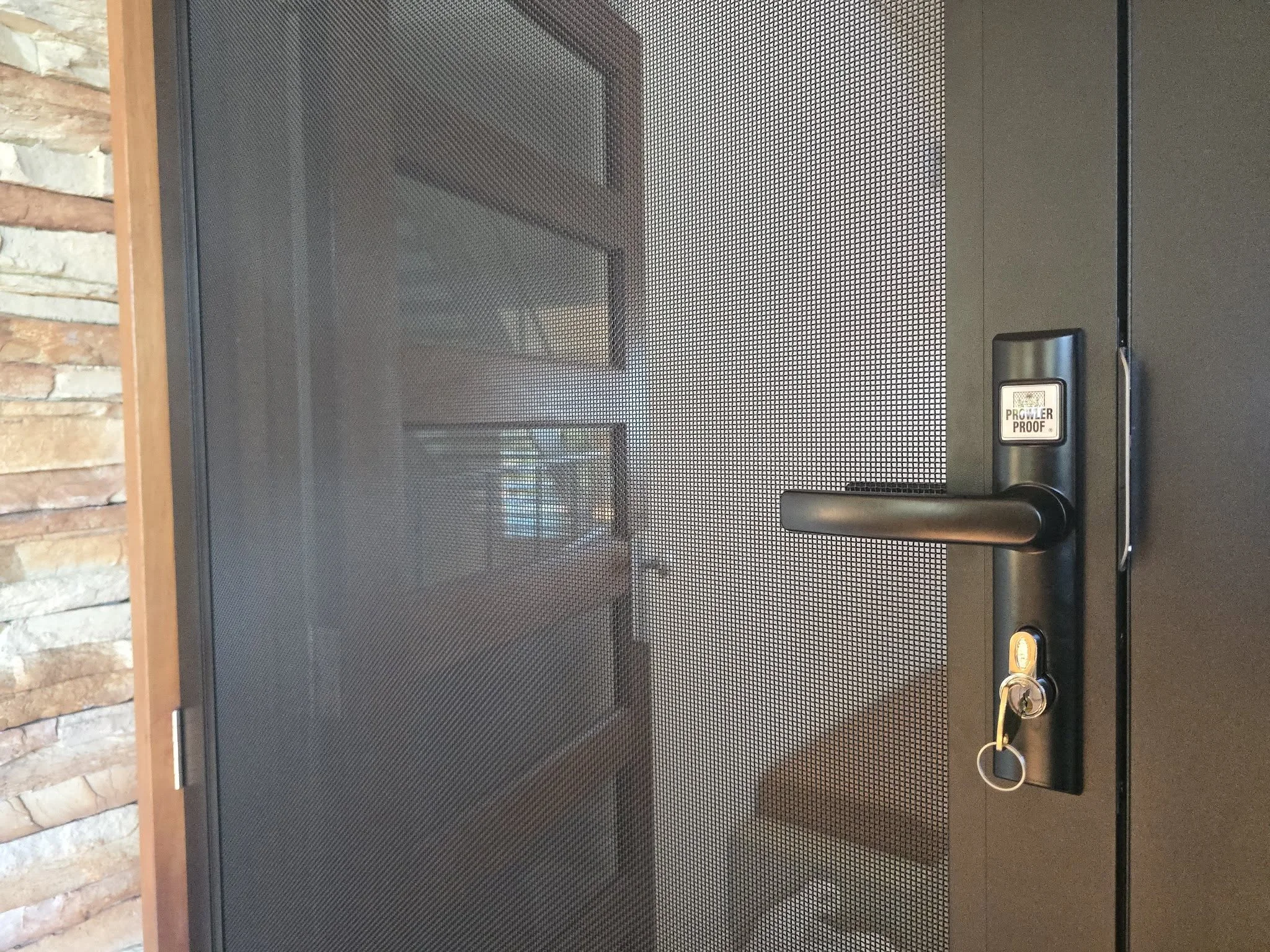
The mesh tells you a lot. Cheaper barrier doors use lightweight aluminium diamond grille or basic flyscreen mesh, and neither will survive a knife or a solid kick.
A genuine security screen uses structural-grade stainless steel mesh, perforated aluminium or heavy steel, all built to resist forced entry.
Be wary of what the industry calls diamond mesh conversions. These are old diamond grille frames fitted with mesh that looks modern and secure but offers no certified protection at all. A moderate kick takes them out.
Look at the Corners and Hinges
The corners of a compliant security door are either fully welded or reinforced with internal corner stakes. A weld is stronger than the metal it joins, while the screws and rivets holding most barrier doors together are weak points that fail under pressure.
The frame should also have a deep receiver channel so the mesh can’t be pushed out.
Hinges matter too. A security door should have at least three fixed-pin hinges, ideally recessed or fitted with guards so they can’t be tampered with from outside. Exposed, removable hinge pins are an open invitation.
The Tests a Real Security Door Has to Pass
Certification isn’t a sticker someone prints off. To meet AS5039, a door is tested at an independent NATA-accredited lab against a series of attacks that mimic what a real intruder would try.
The knife shear test drives a heavy blade into the mesh three times, with a fresh blade each go, and the mesh can’t be cut more than 150mm. The dynamic impact test simulates a kick or a shoulder charge using a heavy weighted swing.
The jemmy test wedges a lever into the locks, hinges and edges to check the door holds against prying with a crowbar or screwdriver. Pull and probe tests then check whether the mesh can be separated from the frame or whether a tool can be pushed through it.
A barrier door has been through none of this. That’s the entire reason it can’t legally be called a security door.

Why Professional Installation Makes or Breaks It
Here’s something a lot of people miss. Even the best security door in the country becomes useless if it’s installed badly.
The standard covers the fitting for a reason. Tolerances down to a few millimetres, the right fixings and a proper measure are what let a door perform the way it did in the lab.
That’s why it pays to use a licensed installer who belongs to the National Security Screen Association. NSSA members are trained in correct installation, audited each year, and held to the standard.
Ask whoever quotes you whether they’re an NSSA member and whether they’re licensed for the work, because in many states that licensing is a legal requirement.
Prowler Proof Security Doors: The Range We Trust
At Screen and Blind Master, the security range we supply and install across the Gold Coast is Prowler Proof. They’re a 100% Australian-owned manufacturer who’ve been making security doors and screens since 1984, and they build every product in a fully automated factory in Banyo, Queensland.
What sets them apart starts with the welded corners. Most manufacturers screw or rivet their frames together, which leaves weak points and gaps where corrosion creeps in.
Every Prowler Proof frame is fully welded instead, so it’s stronger, cleaner looking and far more resistant to rust. The whole security range meets AS5039, and the ForceField and Protec ranges carry the top SL200 security rating.
ForceField
ForceField is the premium option and uses 316 marine-grade stainless steel mesh. It’s nearly invisible and almost impossible to break through.
That makes it ideal for front entries, sliding doors and stacker doors where you want a clear view and plenty of airflow without giving up an ounce of security.
Protec
Protec is a single sheet of perforated aluminium set into a welded frame, and it also hits the SL200 rating.
It gives you a bit more privacy than ForceField while still letting the breeze through, which makes it a smart pick for side entries, rear doors and bedrooms facing the street.
Diamond Security
Diamond Security comes in Welded Diamond and SnapLock options.
It suits secondary doors like laundries and side gates, with the option of insect gauze for added protection against bugs.
Heritage
The Heritage range offers a more decorative, traditional look.
It works beautifully on older and character homes around the Coast, where a classic style is part of the appeal.
Built for Gold Coast Conditions
Living near the water looks great but it’s brutal on cheap hardware. Salt air corrodes inferior screens fast, eating away at the frame and fixings until the whole thing weakens.
This is exactly where ForceField’s 316 marine-grade stainless steel earns its keep, because it’s made to handle coastal conditions and keep performing for years.
The fully welded construction helps here too. With no screws or rivets piercing the frame, there’s nowhere for salt and moisture to start the corrosion that ruins lesser doors.
A 10-Year Replacement Warranty
Prowler Proof backs its products with a 10-year full replacement warranty.
If a product shows a defect in workmanship or materials within ten years of manufacture, it gets replaced with a new one, not patched up. That kind of guarantee only comes from a company confident in what it builds.
The One Check Worth Doing Today
If you’ve got a door at home that someone once called a security door, go and look for the compliance labels. There should be two, one from the manufacturer and one from the installer.
If they’re missing, what you’ve got is a barrier door, no matter what you were told when you bought it.
This is the trick a lot of new home owners get caught by. The builder lists a security door in the inclusions, the door looks the part, and nobody thinks to check. More often than not it’s a barrier door, and the assumption goes unquestioned until it’s tested for real.
If you’ve got a barrier door and want to upgrade to a compliant security door, we can help. For peace of mind and to protect your family, contact us today for a free in-home consultation and we’ll help you pick the right security door for your home.